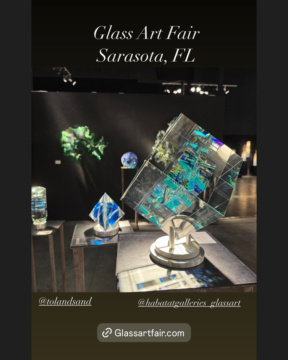

Toland Sand is a vital force in the story of contemporary glass sculpture …
Toland Sand is a renowned glass artist whose innovative techniques and captivating sculptures have earned him a prominent place in the world of contemporary art. With a career spanning over four decades, Sand has continually pushed the boundaries of glass art, exploring new forms, techniques, and artistic expressions. This article delves into the life, work, and creative process of Toland Sand, offering insights into his unique approach to glass sculpture and his contributions to the field.
Early Life and Artistic Journey
Born in Berkeley, California, in 1949, Toland Sand’s early years were marked by the natural beauty of the California coastline, particularly the Carmel and Big Sur areas. These landscapes left an indelible impression on the young artist, influencing his later work’s organic forms and flowing lines.
In 1954, Sand’s family moved due to his father’s career with the CIA. Despite the relocation, they frequently returned to Carmel Valley, solidifying Sand’s connection to the area. This early exposure to diverse environments would later play a crucial role in shaping his artistic vision.
Formative Years in Greece
A significant chapter in Sand’s artistic development unfolded during his teenage years in Greece. Spending five years in Athens, he was immersed in a world of ancient and contemporary architecture and sculpture. The proximity to historical sites like the Parthenon and the Temple at Sounion deeply inspired his artistic sensibilities.
Living near an ancient marble quarry and witnessing laborers chiseling marble for municipal projects became part of Sand’s daily life. This exposure to stonework and classical forms would later influence his approach to shaping and polishing glass sculptures.
Education and Early Career
After his time in Greece, Sand returned to the United States to pursue his education. He graduated from Colorado College in 1971 with a degree in Philosophy. This academic background in critical thinking and abstract concepts would later inform his artistic approach, allowing him to infuse deeper meanings and symbolism into his glass sculptures.
Sand’s journey in glass art began serendipitously in 1976 when he took over a small stained glass business from a friend. This fortuitous event marked the beginning of a lifelong passion and career in glass artistry.
Evolution of Artistic Style
Toland Sand’s artistic career has been characterized by continuous evolution and exploration of different glass-working techniques. His journey can be divided into several distinct phases, each contributing to his growth as an artist and innovator in the field of glass sculpture.
Stained Glass Period (1977-1983)
Sand’s initial foray into glass art focused on stained glass work. He began with geometric sun catchers and quickly progressed to creating 24-inch free-hanging panels with wood frames. During this period, he incorporated blown glass rondels into his designs, initially sourcing them from other artists before learning to create his own.
His stained glass work was characterized by a thoughtful use of color, often employing glasses with related hues to achieve simplicity and elegance. This period saw Sand completing numerous commissions, culminating in a large multi-window installation that marked the end of his stained glass phase.
Blown Glass Era (1984-1986)
In 1984, Sand transitioned to glass blowing, setting up his own hot shop. This period was marked by intense learning and experimentation. The immediacy and plasticity of hot glass provided a new creative outlet for the artist. Sand focused on creating vessels and developed a signature style of pod shapes with angled tops, enhanced by hand-cut stencils and sandblasted designs.
Architectural Glass Work (1986-1988)
Building on his experience with stained and blown glass, Sand began exploring architectural glass applications. This phase saw him creating freestanding sculptures and large-scale installations. A notable project from this period was a light wall in Manchester, New Hampshire, which combined rectilinear and freeform designs to create a dynamic visual effect.
It was during this time that Sand began experimenting with dichroic glass, becoming one of the first artists to incorporate this material into glass sculpture. His use of UV glue to attach dichroic glass pieces to his works laid the foundation for his future sculptural techniques.
Cold Worked Glass (1989-present)
Since 1989, Sand has focused primarily on cold-worked glass sculpture, a technique that has become his signature style. This method involves constructing, cutting, polishing, and reassembling pieces of glass to create complex optical fields and intricate designs.
Sand’s transition to using water-clear optical crystal and optical epoxies marked a significant evolution in his work. This approach allowed him to achieve greater clarity and create more intricate internal structures within his sculptures.
Design Procedures and Techniques
Toland Sand’s creative process is a meticulous journey from concept to finished sculpture, involving several stages of planning, construction, and refinement. Understanding his design procedures offers insight into the complexity and artistry behind each piece.
Conceptualization and Sketching
Every sculpture begins with inspiration and an idea. Sand starts by creating detailed drawings on large white paper, using pencil, ruler, and compass. He employs the traditional three-view approach, sketching the sculpture from different angles to fully visualize the three-dimensional form.
This initial planning stage is crucial, as it allows Sand to explore the potential interplay of light, color, and form before beginning the physical construction of the piece.
Material Selection
The primary materials in Sand’s current work include:
- Optical crystal (both leaded and non-leaded)
- Dichroic coated glass
- Tinted adhesives
- Acrylic paints
The selection of materials is critical, as each component contributes to the final visual effect of the sculpture. Optical crystal provides clarity and brilliance, while dichroic glass adds dynamic color shifts depending on the viewing angle and lighting conditions.
Construction and Shaping
Sand’s sculptures are entirely hand-worked, a process that requires significant skill and patience. The initial shaping of the glass pieces is done by hand, with Sand carefully crafting each component to match his vision.
Once the basic forms are created, Sand employs a series of grinding techniques to refine the shapes further. This process involves multiple stages of increasingly fine abrasives to achieve the desired form and surface texture.
Lamination and Assembly
A key aspect of Sand’s technique is the use of lamination to create complex internal structures within his sculptures. Using optical epoxies, he carefully assembles layers of glass, often incorporating dichroic elements or tinted adhesives between the layers.
This lamination process allows Sand to create intricate optical effects within the solid form of the sculpture. By constructing, cutting apart, polishing, and reassembling components, he achieves a level of internal complexity that is a hallmark of his work.
Polishing and Finishing
The final stage of creation involves an extensive polishing process. Sand uses progressively finer abrasives to bring out the full brilliance of the glass, working through multiple stages until a high polish is achieved.
This meticulous polishing not only enhances the visual clarity of the sculpture but also plays a crucial role in how light interacts with the piece, affecting reflections, refractions, and internal optical effects.
Color Application
While much of the color in Sand’s work comes from the inherent properties of the materials used (such as dichroic glass), he also employs tinted adhesives and acrylic paints to add additional chromatic elements to his sculptures.
The application of color is done with great care, as it can significantly impact the way light travels through and interacts with the sculpture.
Artistic Philosophy and Influences
Toland Sand’s work is deeply rooted in his artistic philosophy and the various influences that have shaped his creative vision over the years.
Balance of Complexity and Simplicity
A central tenet of Sand’s artistic approach is the balance between internal complexity and external simplicity. His sculptures often feature intricate internal structures encased within elegant, streamlined forms. This juxtaposition creates a dynamic viewing experience, inviting observers to explore the depths of the piece while appreciating its overall form.
Exploration of Light and Space
Sand’s work is fundamentally an exploration of how light interacts with space within solid forms. By creating complex internal structures and using materials like dichroic glass, he manipulates how light travels through and reflects within his sculptures. This results in pieces that seem to change and shift as the viewer moves around them or as lighting conditions change.
Symbolism and Language
Influenced by his time in various cultures, particularly his years in Greece and Taiwan, Sand often incorporates elements of symbolism and language into his work. His sculptures sometimes feature forms reminiscent of Eastern ideograms, Greek letters, or Arabic writing, creating a sense of mystery and encouraging viewers to find meaning within the abstract forms.
Spiritual Connection
Sand’s daily meditation practice, inspired by the teachings of his spiritual master Sant Kirpal Singh, informs the mystical and energetic aspects of his work. He sees his creative process as a way to connect with and express the “vibration of the mysteries,” infusing his sculptures with a sense of the transcendent.
Architectural Inspiration
Architecture plays a significant role in Sand’s artistic vision. He often describes his sculptures as “architecture for consciousness,” creating pieces that invite the viewer’s attention to move in and out of the form, much like one might explore a building.
Notable Works and Achievements
Throughout his career, Toland Sand has created numerous significant works and received recognition for his contributions to the field of glass art.
Key Sculptures
While each of Sand’s pieces is unique, some notable works that exemplify his style and technique include:
- Terpsichore Tessera: A sculpture that showcases Sand’s mastery of form and color, featuring intricate internal structures and dynamic light interactions.
- Oloid Blue: This piece demonstrates Sand’s ability to create complex shapes with smooth, flowing lines, inviting viewers to explore its multifaceted surfaces.
- Svoura: A compact yet visually striking sculpture that exemplifies Sand’s skill in balancing simplicity of form with internal complexity.
Exhibitions and Collections
Sand’s work has been exhibited widely and is included in numerous prestigious collections:
- Bergstrom-Mahler Museum of Glass, Neenah, Wisconsin
- Albrecht-Kemper Museum of Art, St. Joseph, Missouri
- Chattanooga Museum of Art, Chattanooga, Tennessee
- University of Michigan Art Museum, Ann Arbor
- The Imagine Museum, St. Petersburg, Florida
Additionally, his sculptures are part of many corporate collections, including those of major companies like IBM, Verizon, and Coca-Cola.
Awards and Recognitions
Sand’s innovative approach to glass art has earned him several accolades, including:
- Art in Public Spaces Award
- Nomination for the 1999 Living Treasure Governor’s Award for New Hampshire
- Participation in the Venice Biennale
The Artist’s Studio and Working Environment
Toland Sand’s creative process is intimately tied to his working environment. For many years, he maintained his primary studio on four wooded acres in rural New Hampshire. This serene setting provided inspiration and a connection to nature that is often reflected in the organic forms of his sculptures.
In July 2016, Sand moved his studio to Carmel Valley, California, returning to the landscape that first inspired him as a child. This relocation marked a new chapter in his artistic journey, potentially influencing the evolution of his work.
Regardless of location, Sand’s studio is equipped with the specialized tools and equipment necessary for his cold-working techniques. This includes various grinding and polishing machines, as well as a carefully organized space for the precise assembly and lamination processes that his work requires.
The Future of Glass Art and Toland Sand’s Legacy
As Toland Sand continues to create and innovate, his influence on the field of glass art remains significant. His pioneering use of dichroic glass and complex lamination techniques has inspired a new generation of artists to explore the possibilities of cold-worked glass sculpture.
Sand’s commitment to pushing the boundaries of his medium, combined with his philosophical approach to art-making, positions him as a key figure in the ongoing evolution of contemporary glass art. His work serves as a bridge between traditional glassworking techniques and modern sculptural concepts, encouraging both artists and viewers to see glass as a medium of limitless potential.
As the art world continues to evolve, Toland Sand’s legacy is likely to be defined by his innovative techniques, his exploration of light and form, and his ability to infuse glass sculptures with depth, meaning, and a sense of the mystical. His journey from stained glass craftsman to internationally recognized sculptor serves as an inspiration to aspiring artists and a testament to the power of continuous exploration and innovation in artistic practice.
In conclusion, Toland Sand’s contributions to the world of glass art extend far beyond the physical beauty of his sculptures. Through his meticulous craftsmanship, innovative techniques, and thoughtful approach to design, he has helped to elevate glass from a craft material to a medium for high art. As he continues to create and inspire, Toland Sand remains a vital force in the ongoing story of contemporary glass sculpture.